

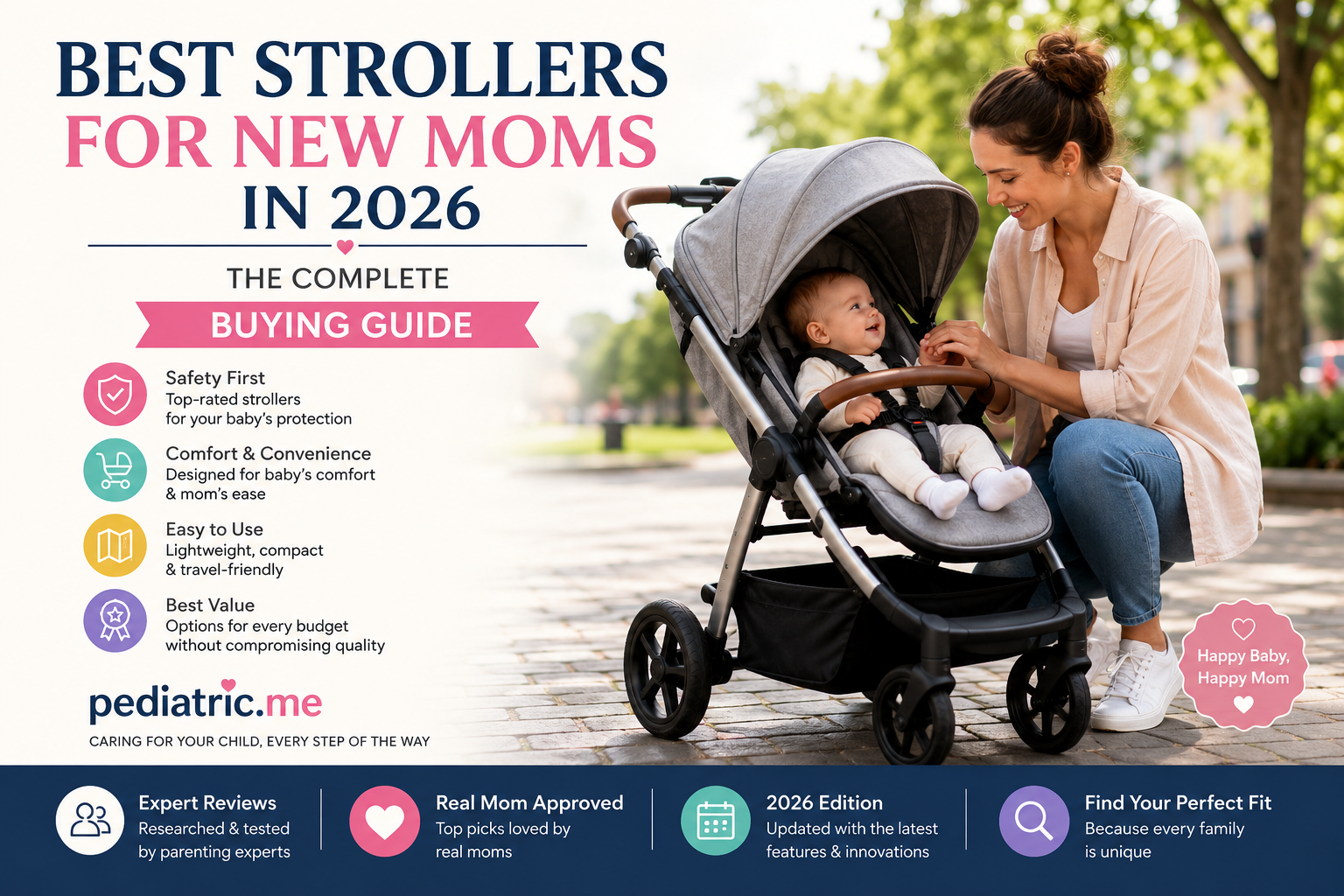
Best Strollers for New Moms in 2026: The Complete Buying Guide
Few purchases feel as high-stakes to a new mom as the stroller. It’s the thing you’ll touch every single day for years — on sidewalk cracks, airport jet bridges, grocery store aisles, and 6 a.m. walks when nothing else will settle the baby. With dozens of brands and even more configurations, it’s easy to get stuck comparing spec sheets instead of thinking about your actual life. This guide breaks down the best strollers of 2026 by real-world use case, so you can buy once and buy right.
How to Choose the Right Stroller (Before You Shop)
Before comparing individual models, run through these five questions. They’ll narrow the field faster than any spec sheet:
- Newborn-ready or not? Babies need to lie flat or use an infant car seat until they can sit up (around 4–6 months). Confirm the stroller accepts a bassinet or car seat if you’ll use it from day one.
- City or all-terrain? Small front wheels are great for tight apartment hallways and store aisles; larger, air- or foam-filled wheels handle gravel, grass, and uneven sidewalks far better.
- How will it fold — and where will it live? One-hand fold and self-standing when folded matter enormously if you’re loading a trunk solo with a baby on your hip.
- One kid or more? If you’re planning for a second child soon, a stroller with an approved second-seat or bassinet attachment can save you from buying twice.
- What’s your actual budget ceiling? Excellent strollers exist from roughly $150 to $1,500+. More expensive doesn’t automatically mean safer — CPSC standards apply to every stroller legally sold in the U.S. — it usually buys smoother ride quality, storage, and longevity.
Best Strollers of 2026, By Category
🏆 Best Overall: UPPAbaby Cruz V3
The Cruz V3 is the stroller most gear reviewers keep coming back to for a reason: it grows with your family from newborn through toddlerhood, the seat reclines flat and reverses to face you or the world, and the no-rethread harness means you’re not fiddling with straps every few months as your baby grows. It pairs with an infant car seat or bassinet (sold separately) for newborn use. Note that it’s a single-seat stroller only — it doesn’t convert to a double.
✅ Amazon: Shop the UPPAbaby Cruz V3 on Amazon →
💰 Best Budget Travel System: Graco Pramette
For parents who want a car seat and stroller in one box without a premium price tag, Graco’s Pramette system is hard to beat. It includes a SnugRide infant car seat that clicks directly onto the frame, a near-flat “pramette” mode for the newborn stage, a reversible toddler seat, and a one-hand fold — usually for a few hundred dollars less than comparable luxury systems. It’s a reliable, no-frills pick that plenty of families run through two or three kids.
✅ Amazon: Shop the Graco Pramette Travel System on Amazon →
✈️ Best Lightweight / Travel Stroller: Mima Miro or Nuna TRVL
If you’re chasing portability — flights, rideshares, small trunks — look for a stroller under 15 lbs that folds compactly and can self-stand when closed. The Mima Miro has a sleek, low profile that doesn’t scream “stroller,” while the Nuna TRVL line (including a double-friendly version) keeps the same lightweight philosophy for families with two kids close in age.
✅ Amazon: Shop lightweight travel strollers on Amazon →
🏃 Best Jogging Stroller: Thule Urban Glide 3
For active parents who want to keep running or hiking after baby arrives, a dedicated jogging stroller with a fixed front wheel and larger air-filled tires offers far better shock absorption and straight-line stability than an all-terrain everyday stroller. The Thule Urban Glide 3 is consistently rated among the smoothest rides in this category, with excellent maneuverability for a jogger.
✅ Amazon: Shop the Thule Urban Glide on Amazon →
👯 Best All-in-One / Growing Family Stroller: Momcozy ChangeGo
If you want one purchase to carry you from newborn through preschool — and potentially through a second baby — the Momcozy ChangeGo is built to reconfigure between a single stroller, a double stroller, and (with an add-on) a wagon. It ships with the bassinet, rain cover, and travel bag included, which is where most competing systems tack on hundreds of dollars in extras.
✅ Amazon: Shop the Momcozy ChangeGo on Amazon →
🔄 Best Rotating-Seat Stroller: Maxi-Cosi Tana
The Tana’s standout feature is a seat that rotates 180 degrees, letting you switch your baby between facing you and facing forward without detaching or flipping the seat unit — a small feature that makes a big daily difference for parents who like to keep an eye (and a conversation) going with their baby.
✅ Amazon: Shop the Maxi-Cosi Tana on Amazon →
Stroller Safety Checklist
- Register your stroller with the manufacturer as soon as you buy it — this is how you’ll get notified of any recall.
- Check the model against the CPSC Recalls & Product Safety Warnings database before buying secondhand.
- Always use the 5-point harness, even for a “quick” walk to the mailbox.
- Engage the brake every time you stop, even on flat ground.
- Never hang heavy bags from the handlebar — it can tip the stroller backward.
Frequently Asked Questions
What’s the best stroller for a newborn?
Newborns need to lie flat or ride in an infant car seat until they have the head and neck control to sit up, typically around 4–6 months. Look for a stroller that either accepts an infant car seat via an adapter, includes or supports a bassinet attachment, or has a seat that reclines to a near-flat “pramette” position.
Do I really need an expensive stroller?
No. Every stroller legally sold by a U.S. retailer has to meet Consumer Product Safety Commission (CPSC) safety standards, so a budget-friendly model isn’t inherently less safe than a premium one. What you’re paying more for at the higher end is typically ride smoothness, build materials, storage capacity, and how well the stroller holds up over years of daily use.
What’s the difference between a travel system and a standalone stroller?
A travel system is sold as a bundle that includes both an infant car seat and a stroller frame designed to click together, so the baby can move from car to stroller without waking up. A standalone stroller is sold on its own and may or may not be compatible with car seats via a separate adapter.
Can one stroller really last from newborn to preschool?
Some can. Look for a “modular” or “convertible” system with a weight capacity of 50 lbs or more, a seat that reclines flat for newborns and sits upright for toddlers, and (if you want it to handle a second child down the line) an approved second-seat or bassinet attachment.
How much should I budget for a stroller?
Solid, safe strollers exist across a wide range — roughly $150–$400 for budget and mid-range picks, and $600–$1,500+ for premium travel systems and modular strollers with more accessories included. Your realistic budget should factor in whether you’ll also need to buy a bassinet attachment or infant car seat separately.
Jogging stroller vs. all-terrain stroller — what’s the real difference?
A true jogging stroller has a fixed (non-swiveling) front wheel for stability at running speeds, larger air-filled tires, and a hand brake. An all-terrain everyday stroller usually has a swiveling front wheel for tight turns and smaller wheels — better for daily errands, but not built for the impact of actual running.
Related Reading
- Choosing the Best Stroller: A Comprehensive Guide
- Newborn Essentials: The Ultimate Baby Registry Checklist
- Hospital Bag Checklist: What to Pack for Labor, Delivery & Baby’s First Days
- Best Baby Monitors of 2026: Tested Picks for Every Type of Parent
- How Do I Choose the Right Car Seat?
This article contains affiliate links to Amazon. As an Amazon Associate, pediatric.me may earn from qualifying purchases at no additional cost to you. Prices and product availability are subject to change — always confirm current details and safety recalls before purchasing.