

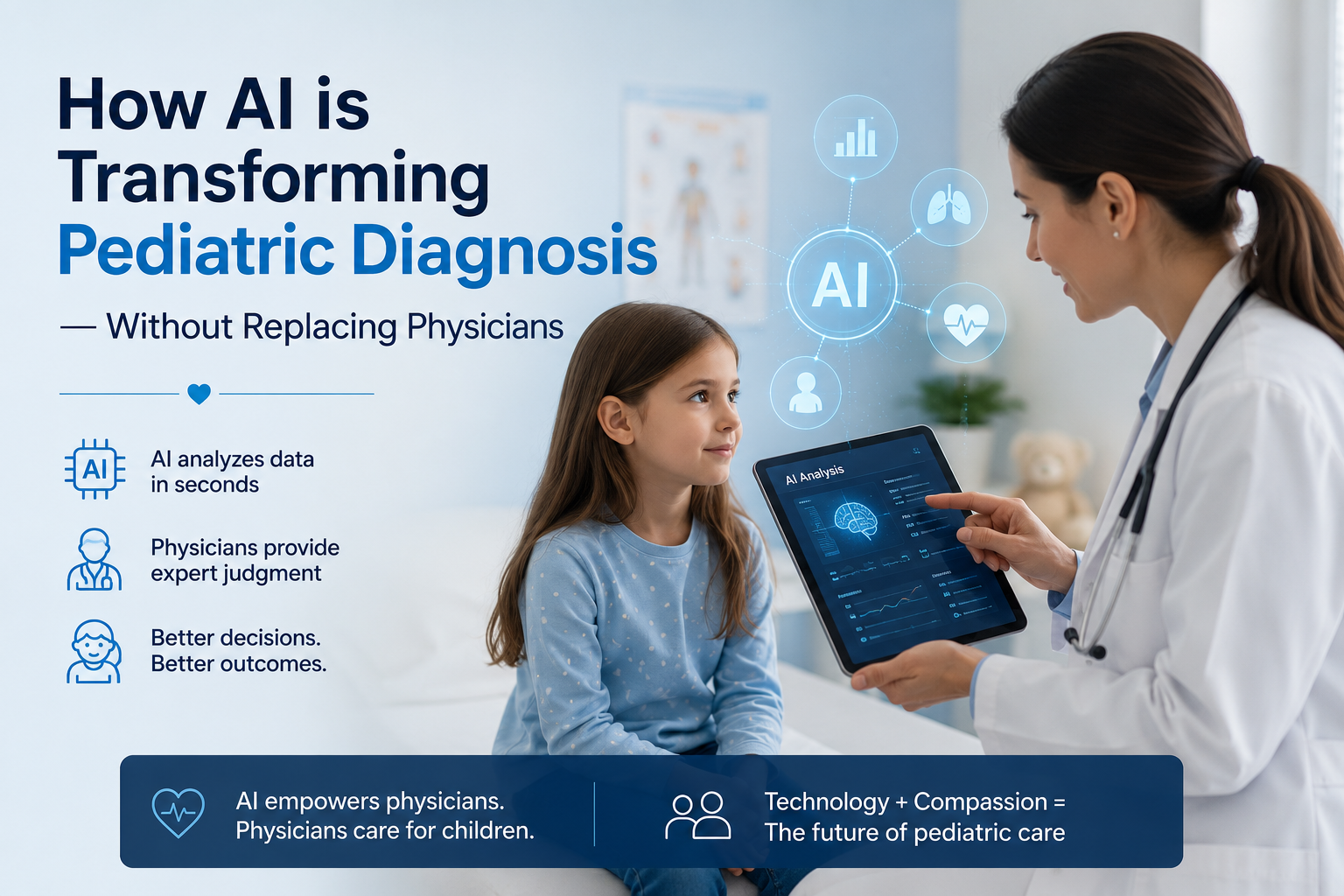
How AI Is Transforming Pediatric Diagnosis Without Replacing Physicians
Artificial intelligence has moved from theoretical promise to daily clinical reality in pediatrics faster than almost any other subspecialty. Algorithms now flag early signs of sepsis in the NICU, screen retinal images for retinopathy of prematurity, and help triage rashes, coughs, and developmental concerns before a child ever sees a physician. For many pediatricians, the natural question isn’t whether AI belongs in the exam room — it’s how much, and at what cost to the clinical relationship that defines the specialty.
The short answer: AI is proving most valuable not as a diagnostician, but as an amplifier of physician judgment — and the data increasingly supports keeping it that way.
Where AI Is Already Making a Difference
Pediatric diagnosis has always been harder than adult medicine in one crucial respect — children, especially preverbal ones, can’t reliably self-report symptoms. This diagnostic uncertainty is exactly where machine learning tools have found their footing:
- Early sepsis and deterioration detection. Models trained on vital sign trends in NICUs and PICUs can detect subtle physiological drift hours before clinical staff would otherwise notice, giving care teams a critical head start.
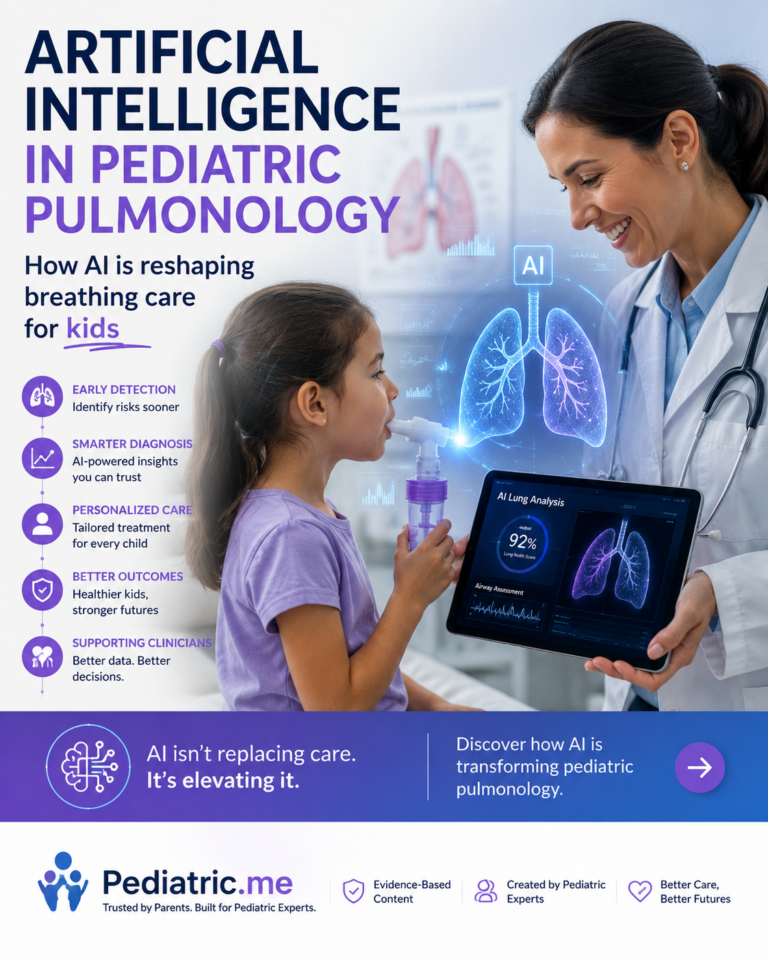
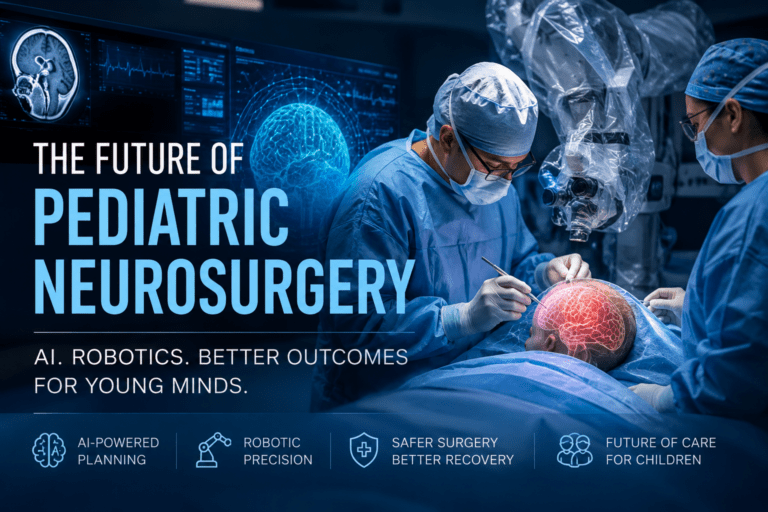
- Imaging and screening support. AI-assisted screening for retinopathy of prematurity, pediatric bone age assessment, and congenital heart defect detection on echocardiograms have shown accuracy comparable to subspecialists in several validation studies — while dramatically reducing the time to a first read.
- Symptom-checking and triage. Parent-facing AI symptom-checking tools help families decide whether a fever, rash, or injury needs a same-day visit, an urgent care trip, or watchful waiting — reducing unnecessary ED visits without delaying care for genuine emergencies.
- Developmental and behavioral screening. Natural language and video-based tools are beginning to assist in flagging early markers of autism spectrum disorder and speech delay, prompting earlier referral to specialists.
- Genomic and rare disease diagnosis. AI-assisted phenotype matching has cut the diagnostic odyssey for some rare pediatric genetic conditions from years to weeks by cross-referencing symptoms against vast genomic databases far faster than manual literature review.
Why AI Isn’t Replacing the Pediatrician
Despite these gains, every major clinical deployment of pediatric AI shares a common design principle: a human remains in the loop. There are structural reasons this isn’t likely to change:
- Children are not small adults, and pediatric data is scarce. Most large medical AI models are trained predominantly on adult data, which limits their reliability across the wide physiological range from neonate to adolescent. Pediatricians’ contextual knowledge of age-specific presentation still outperforms generalized models in ambiguous cases.
- Diagnosis in pediatrics is relational, not just computational. A caregiver’s description, a physician’s read of a child’s affect, family history, and social context (feeding, sleep, home environment) all inform a diagnosis in ways that are difficult to fully encode into a model — and AI systems perform worse when this context is missing.
- Liability and trust remain physician-anchored. Parents consistently report wanting a human physician to make and explain the final call, particularly for anything beyond minor acute illness — and regulatory frameworks in most jurisdictions still require clinician sign-off on AI-assisted diagnostic outputs.
- AI tools are pattern-matchers, not reasoners. They excel at flagging statistical anomalies against known patterns but struggle with the kind of open-ended clinical reasoning pediatricians use when a child’s presentation doesn’t fit a known pattern — which is common in a population still developing.
The Physician’s Expanding Role
Rather than shrinking the pediatrician’s role, AI is shifting it upstream and downstream of the diagnostic moment itself:
- Upstream: reviewing and calibrating AI triage output before it reaches a family, and deciding which flagged cases warrant escalation.
- In the visit: using AI-generated summaries, ambient documentation, and decision-support prompts to spend more face time with the patient and less time on the EHR.
- Downstream: translating an AI-flagged risk or genomic match into a treatment plan that accounts for the family’s values, resources, and the child’s developmental stage — work no algorithm can currently replicate.
What This Means for Your Practice
Pediatricians evaluating AI tools should look for three things: transparent validation data specific to pediatric populations (not just adapted adult models), clear human-override workflows, and integration that reduces — rather than adds to — documentation burden. Tools that meet this bar tend to free up time for the parts of pediatric care that remain irreducibly human: reassurance, relationship, and judgment under uncertainty.
AI in pediatrics is best understood not as a replacement for the physician, but as a very fast, very literal-minded resident who never gets tired of watching the monitors — one that still needs an attending to make the final call.
Related on Pediatric.me
- Child Symptom Checker — When to See a Doctor
- Baby Milestone Tracker — Personalized Development Checklist
- What Is the Modified Checklist for Autism in Toddlers (M-CHAT)?
- Issues Treated by Pediatric Geneticists
- Types of Pediatricians Explained