


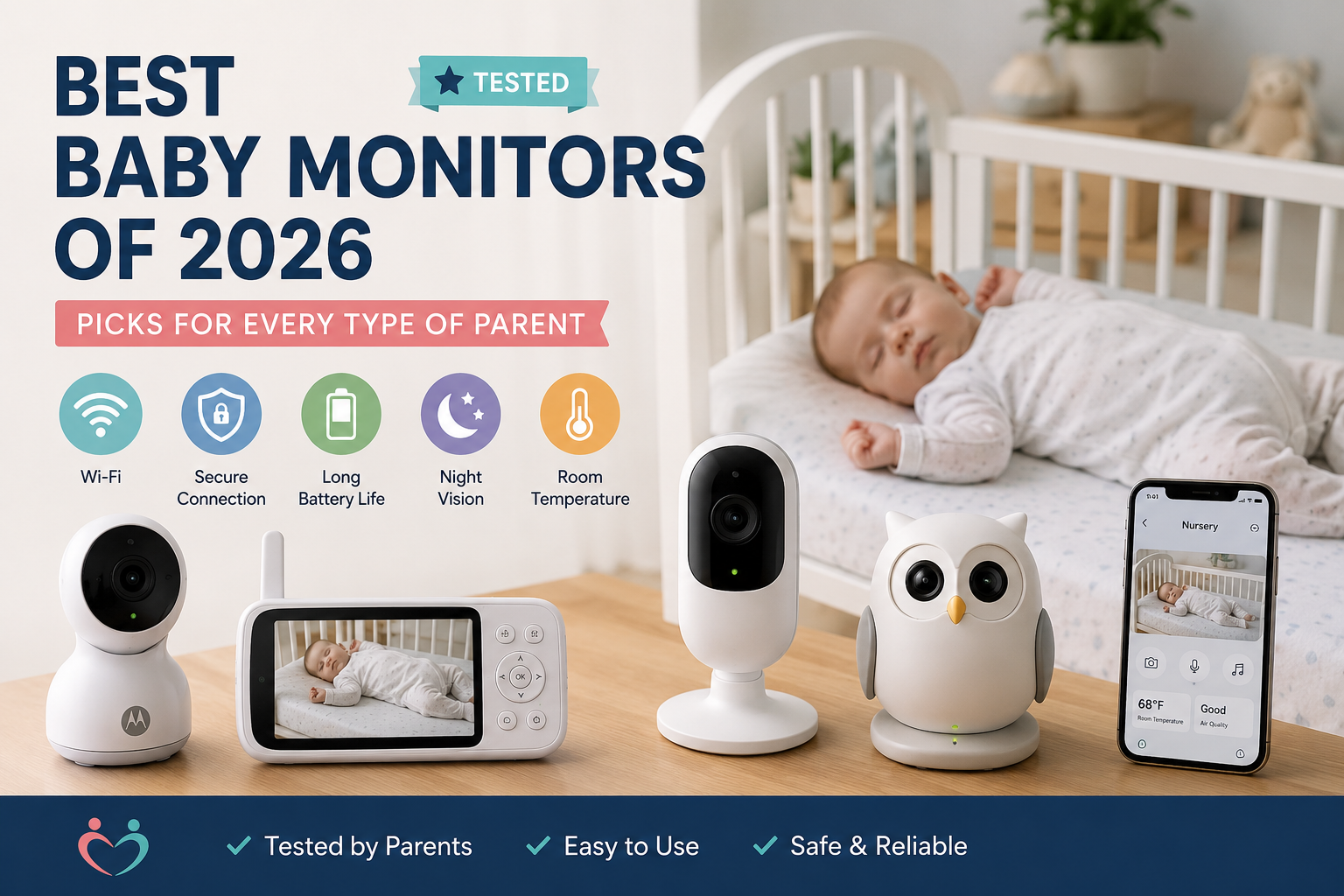
Best Baby Monitors of 2026: Tested Picks for Every Type of Parent
There isn’t one “best” baby monitor — there’s a best monitor for you. A parent who wants sleep insights needs something very different from a parent who just wants a reliable picture and audio feed with zero subscriptions. Below is a breakdown of the top monitors in 2026 by category, so you can match the pick to how you actually parent.
Quick Answer: Top Picks at a Glance
| Best For | Monitor | Why It Wins |
|---|---|---|
| Most families (overall pick) | Nanit Pro | HD video, sleep tracking, huge ecosystem of accessories |
| Health & vitals monitoring | Owlet Dream Duo 3 | FDA-cleared pulse oximetry wearable + camera |
| No WiFi, no subscriptions | eufy Security E21 | 4K video, works with or without WiFi, no monthly fee |
| Best budget pick | VTech VM819 | Reliable non-WiFi video monitor under $50 |
| Best dual-mode (WiFi + non-WiFi) | Momcozy BM04 | Secure radio unit at home, app access on the go |
| Long battery life | HelloBaby HB6550 | Up to 30 hours on a single charge |
How We Compared These Monitors
Every pick below was evaluated on the factors that actually matter to new parents: picture and audio quality, range, battery life, ease of setup, whether a subscription is required for core features, and — increasingly important in 2026 — whether the monitor can work fully without sending video to the cloud.
1. Nanit Pro — Best Overall
The Nanit Pro is the category’s most complete “smart” monitor: full 1080p HD resolution, a built-in nightlight, and Nanit’s well-regarded Insights platform for sleep pattern tracking. It pairs with breathing-motion wearables for parents who want an extra layer of reassurance. The tradeoff is cost — the camera itself runs around $289, and the most useful sleep-insight features sit behind a $5–10/month subscription.
Best for: parents who want data-driven sleep coaching and don’t mind an ongoing subscription.
🛒 Check current price on Amazon: Nanit Pro Smart Baby Monitor
2. Owlet Dream Duo 3 — Best for Health & Vitals
The Dream Duo 3 pairs an HD camera with the Owlet Dream Sock, the only widely available FDA-cleared pulse-oximetry wearable on the market. It tracks heart rate and oxygen saturation and sends real-time alerts if readings fall outside a normal range. It’s a favorite among parents of preemies or infants with a history of respiratory or cardiac concerns — though it’s worth noting the AAP does not recommend wearable monitors as a substitute for standard SIDS-prevention practices (back-to-sleep, firm mattress, no loose bedding).
Best for: parents who specifically want vitals monitoring, not just video/audio.
🛒 Check current price on Amazon: Owlet Dream Duo 3
3. eufy Security E21 — Best No-Subscription Pick
The eufy E21 delivers 4K video and flexible WiFi/non-WiFi operation without ever requiring a monthly fee — footage stores locally rather than in the cloud, which also appeals to privacy-conscious parents. At roughly $180–260 depending on bundle, it undercuts Nanit while matching most of its picture quality.
Best for: parents who want premium video quality without a recurring bill.
🛒 Check current price on Amazon: eufy Security E21 Baby Monitor
4. VTech VM819 — Best Budget Pick
Under $50, the VM819 remains one of the most reliable non-WiFi video monitors on the market. It won’t wow anyone with features — the camera angle is manual, and there’s no app — but the picture is clear, the connection is a dedicated radio frequency (not hackable like an unsecured WiFi feed), and it just works.
Best for: budget-conscious parents who want the basics done well.
🛒 Check current price on Amazon: VTech VM819 Video Baby Monitor
5. Momcozy BM04 — Best Dual-Mode Monitor
Dual-mode monitors are the newest and arguably smartest category in 2026: a secure, non-WiFi radio parent unit for everyday home use, plus an optional WiFi app connection for when you’re away (date nights, grandma’s house). The BM04’s 1080p camera pans 350°, includes cry detection and safe-zone alerts, and needs no subscription.
Best for: parents who can’t decide between privacy at home and remote access when traveling.
🛒 Check current price on Amazon: Momcozy BM04 Baby Monitor
6. HelloBaby HB6550 — Best Battery Life
If you move the monitor around the house a lot, or travel frequently, the HB6550’s roughly 30-hour battery life is hard to beat. It trades some picture sharpness and range for that endurance, so it’s better suited to close-range home use than large houses or long-distance range needs.
Best for: parents who want the least amount of charging-cable anxiety.
🛒 Check current price on Amazon: HelloBaby HB6550 Baby Monitor
WiFi vs. Non-WiFi: Which Should You Choose?
This is the single biggest decision point in 2026’s baby monitor market:
- Non-WiFi monitors use a dedicated radio frequency (usually FHSS-encrypted), which can’t be accessed remotely — meaning they also can’t be hacked the way an unsecured WiFi camera could be. They’re simpler, cheaper, and don’t require an app or account.
- WiFi monitors let you check on your baby from anywhere via smartphone app — useful if you travel, work from an office, or have a co-parent who wants remote access.
- Dual-mode monitors (Momcozy BM04, VTech VM901, and similar) solve this by offering both: a private, non-WiFi connection for home use, and an optional app connection for when you’re away.
If you’re unsure, a dual-mode monitor is the safest default — you get the privacy of a closed system at home without giving up remote access entirely.
Do You Need a Health-Tracking Wearable?
Wearables like the Owlet Dream Sock or Nanit’s breathing band track vitals like heart rate, oxygen saturation, or breathing motion, and can offer real peace of mind — particularly for parents of preemies or infants with a known health condition. That said, the American Academy of Pediatrics does not recommend consumer wearables as a replacement for evidence-based SIDS-prevention practices. Think of them as an added layer of reassurance, not a medical device that replaces safe-sleep basics — unless it’s specifically an FDA-cleared device recommended by your pediatrician.
Frequently Asked Questions
What is the best baby monitor overall in 2026?
For most families, the Nanit Pro is the best all-around pick thanks to its HD video quality and sleep-tracking features, though it does require a subscription for full functionality.
Do I need a WiFi baby monitor, or is non-WiFi safer?
Non-WiFi monitors are generally considered more secure since they use a closed radio frequency that can’t be remotely accessed. WiFi monitors add convenience — you can check in from anywhere — but require good account security (strong password, two-factor authentication) to stay private.
What’s the difference between a baby monitor and a baby health wearable?
A traditional baby monitor provides video and/or audio only. A wearable, like the Owlet Dream Sock, tracks physiological data such as heart rate and oxygen levels. Some products, like the Owlet Dream Duo, combine both in one system.
Are baby monitor subscriptions worth it?
It depends on the features you want. Subscriptions (common with Nanit and some Owlet products) typically unlock sleep analytics, extended cloud video history, or advanced alerts. If you only want live video and basic motion/sound alerts, several no-subscription monitors (eufy, VTech, Momcozy, HelloBaby) cover that without an ongoing fee.
How much should I expect to spend on a baby monitor?
Budget non-WiFi monitors start around $50. Mid-range dual-mode monitors run $130–$200. Premium smart monitors with health tracking (Nanit Pro, Owlet Dream Duo) range from roughly $250–$400, plus optional subscription costs.
Can baby monitors prevent SIDS?
No baby monitor, wearable or otherwise, is proven to prevent SIDS. The AAP recommends safe-sleep practices — back sleeping, a firm mattress, and an empty crib — as the primary prevention strategy, regardless of what monitoring technology you use.
Related Reading
- Newborn Sleep Safety: A Room-by-Room Setup Guide
- Best Cribs and Bassinets of 2026, Tested
- How to Create a Safe Sleep Environment (AAP Guidelines Explained)
- Nursery Essentials Checklist: What You Actually Need
- Best Baby Monitors for Twins or Multiple Rooms
(These will be linked to live pediatric.me posts once matching articles are identified/published.)
Disclosure: This article contains affiliate links. As an Amazon Associate, pediatric.me may earn a commission from qualifying purchases at no additional cost to you. Prices and availability are accurate as of publication but may change.