

Fever in Babies and Kids: When to Worry, by Age
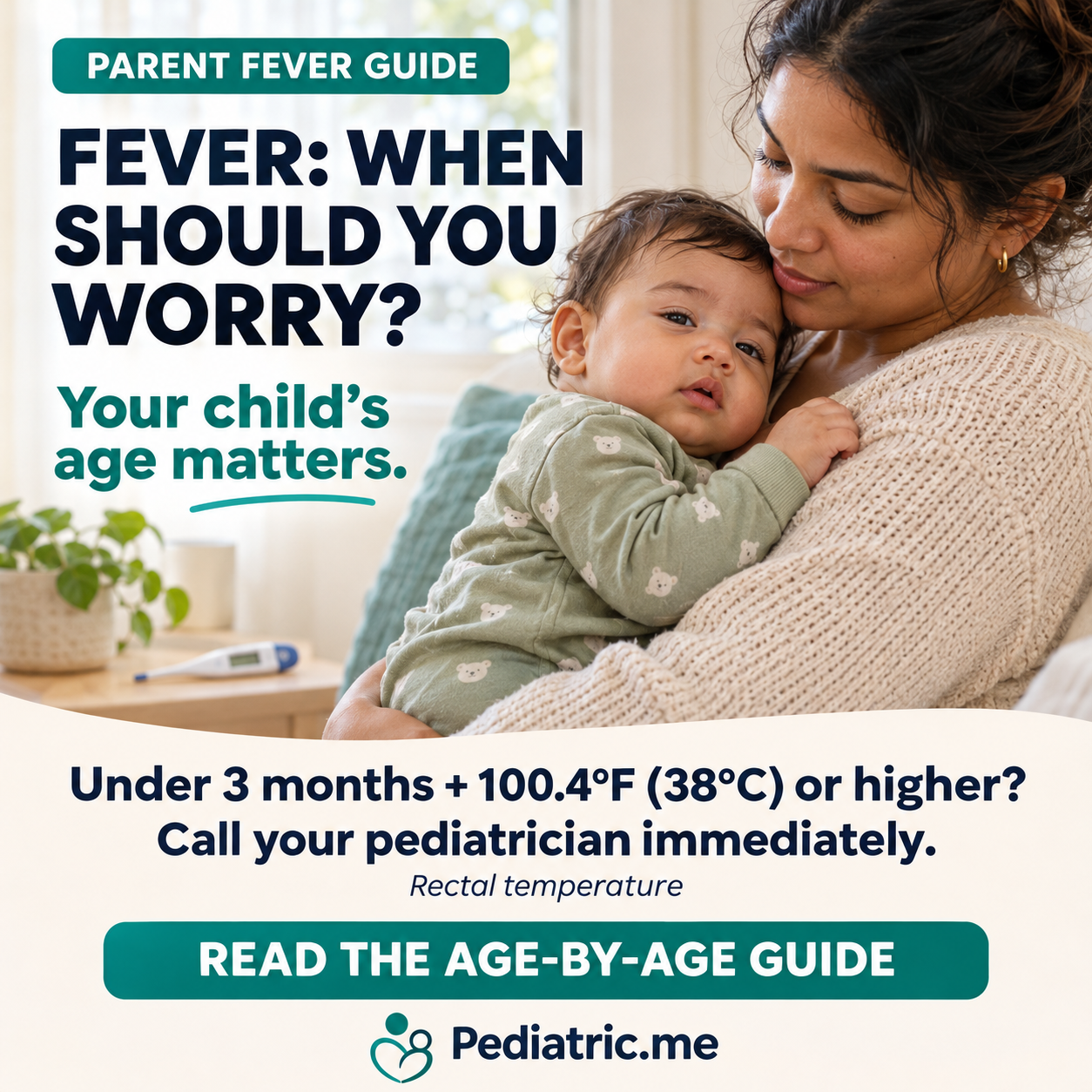
Quick answer: A rectal temperature of 100.4°F (38°C) or higher is a fever. What matters most is your child’s age. Newborns under 3 months with any fever need emergency care right away. Babies 3–6 months need a same-day call to the pediatrician. For older kids, the number matters less than how your child looks and acts—and whether the fever lasts more than three days.
What counts as a fever?
A fever is a body temperature of 100.4°F (38°C) or higher. For babies under 3 months, rectal temperature is the most accurate method and the one the American Academy of Pediatrics (AAP) recommends. For older children, an armpit (axillary) reading is convenient for screening, but add about half a degree to compare it to rectal values. Ear and forehead thermometers can be used in children over 6 months once you have been shown the correct technique.
Normal body temperature hovers around 98.6°F (37°C) but can vary by half a degree in either direction throughout the day—lowest in early morning, highest in late afternoon. A temperature of 99–100.3°F is not a fever; it is a normal variation.
Age-by-age fever guidelines (AAP)
Newborns under 3 months (0–89 days)
This is the highest-risk group. An infant in this age range has an immature immune system and may harbor a serious bacterial infection—such as meningitis or a bloodstream infection—without showing the obvious signs older children do. A rectal temperature of 100.4°F (38°C) or higher in a baby under 3 months is a medical emergency. Do not give fever-reducing medicine and wait to see if it helps. Go to the emergency room or call 911.
Similarly, a temperature below 97.5°F in a newborn (hypothermia) is also concerning and warrants immediate evaluation.
Babies 3–6 months
A fever of 100.4°F (38°C) or higher in this age group still warrants a same-day call to your pediatrician. Your doctor will assess the situation and may ask you to come in or go to urgent care. If your baby looks very sick, is unusually drowsy, or is having trouble breathing at any temperature, call 911 or go to the ER.
A baby of 4 or 5 months who has a temp of 102°F but is nursing well, making tears, smiling at you, and alert is a very different situation from a baby of the same age who is limp and not responding. Always describe your baby’s behavior to the nurse or doctor, not just the number.
Babies 6–24 months
Once babies are past 6 months and have received their first round of vaccines, the risk of serious bacterial infection with a fever drops considerably. The AAP guidance for this group:
- A fever of 102.2°F (39°C) or higher lasting more than one day (24 hours) without a clear source (like an obvious cold or ear infection) deserves a call to your doctor.
- Any fever that persists for more than 3 days should be evaluated regardless of height.
- Fever accompanied by a rash, difficulty breathing, severe ear pain, or stiff neck needs same-day care.
At this age, teething can cause a very slight temperature rise (usually below 100°F), but teething does not cause a true fever above 100.4°F. If your baby has a real fever, look for another cause.


Toddlers and preschoolers (2–5 years)
In children over 2, the absolute height of the fever is less important than how your child is acting. A child with a temp of 103.5°F who is drinking fluids, playing, and making eye contact is usually less worrying than a child with a temp of 101°F who is limp, refusing to drink, and not responding normally.
Call your pediatrician if:
- The fever reaches 104°F (40°C) or higher at any point.
- The fever lasts more than 3 days.
- Your child seems to be getting worse instead of better after the first 2 days.
- A fever goes away for 24 hours and then comes back.
One important note for this age group: children between 6 months and 5 years can occasionally experience febrile seizures—brief convulsions triggered by a sudden rise in temperature. They look frightening but are almost always harmless. They do not cause brain damage, and most children who have one never have another. If your child has a febrile seizure, call your doctor—but stay calm, do not put anything in their mouth, and note how long it lasts.
School-age children (6 years and older)
Healthy older kids generally handle fever well. The main reasons to call your doctor are:
- Fever above 104°F (40°C).
- Fever lasting more than 5 days.
- Symptoms suggesting a specific illness that needs treatment—such as a sore throat with no runny nose (possible strep), a cough lasting more than 2 weeks, or significant ear pain (possible ear infection).
Fever during influenza in school-age kids can spike to 104°F and last 3–5 days. If your child has had the flu vaccine and still gets a high fever with body aches and fatigue, flu is a common culprit—rest and fluids are the mainstay of treatment.
How to bring down a fever comfortably
Fever-reducing medicines can help your child feel more comfortable, but they will not shorten the underlying illness. Options for children:
- Acetaminophen (Tylenol): Safe from 2 months of age and older (with doctor guidance for very young infants). Dose is based on weight, not age.
- Ibuprofen (Advil, Motrin): Safe from 6 months of age. Also dosed by weight. Not recommended for children under 6 months.
- Never give aspirin to children or teenagers—it is linked to a rare but serious condition called Reye’s syndrome.
Note that the AAP does not recommend over-the-counter cough and cold medicines for children under 6 years, and many combination products contain acetaminophen—read labels carefully to avoid accidental double-dosing.
Lukewarm sponge baths can make a feverish child feel temporarily better but do not lower the fever’s setpoint. Avoid ice water or alcohol rubs, which can cause shivering and worsen discomfort. Dress your child in light clothing and keep the room comfortably cool.
When to call your pediatrician
Call your doctor’s office (or after-hours line) any time you are worried, and specifically when:
- Your baby is 3–6 months with any fever.
- Your child (any age) has a fever above 104°F (40°C).
- Fever lasts more than 3 days in a child under 2, or more than 5 days in a child over 2.
- Fever goes away for more than 24 hours, then returns.
- Your child has a chronic medical condition, is immunocompromised, or has sickle cell disease.
- Your child is very difficult to wake up or unusually fussy and cannot be comforted.
When to go to the emergency room
Head to the ER immediately if your child of any age has:
- Fever in a baby under 3 months (less than 90 days old).
- Difficulty breathing or fast breathing that does not improve.
- Lips, fingernails, or skin turning blue or gray.
- A stiff neck (chin unable to touch chest).
- A purple or red spotted rash that does not fade when pressed (non-blanching)—this can signal meningococcal disease.
- Severe belly pain or persistent vomiting.
- Bulging soft spot (fontanelle) on a baby’s head.
- Seizure lasting more than 5 minutes, or a second seizure in the same illness.
- You cannot wake your child, or your child is confused or unresponsive.
Frequently asked questions
- What temperature is a fever in a baby?
- A rectal temperature of 100.4°F (38°C) or higher is a fever at any age. For babies under 3 months, this is a medical emergency requiring immediate care.
- When should I take my baby to the ER for a fever?
- Any fever in a baby under 3 months (under 90 days) requires an ER visit. Older children need emergency care if they have difficulty breathing, a non-blanching rash, a stiff neck, a seizure, or are unresponsive.
- How long is too long for a fever in a child?
- A fever lasting more than 3 days in a child under 2 years, or more than 5 days in an older child, should be evaluated by a doctor, even if the child seems otherwise well.
- Can I give ibuprofen and acetaminophen together for a high fever?
- Alternating the two medicines can be done but is generally not recommended unless a doctor advises it. Using one medicine correctly and consistently is usually sufficient. Never give ibuprofen to children under 6 months.
- Does teething cause fever?
- Teething may cause a very slight temperature rise, but it does not cause a true fever above 100.4°F. If your baby has a real fever during teething, look for another cause and call your pediatrician.
Sources
- American Academy of Pediatrics / HealthyChildren.org. Fever and Your Baby. healthychildren.org
- American Academy of Pediatrics / HealthyChildren.org. How to Take a Child’s Temperature. healthychildren.org
- American Academy of Pediatrics / HealthyChildren.org. Fever Without Fear. healthychildren.org
- U.S. National Library of Medicine / MedlinePlus. Fever in Children. medlineplus.gov
Disclaimer: This article is for general informational purposes only and does not constitute medical advice. Always consult your child’s pediatrician or a qualified healthcare provider with questions about your child’s health or before making any medical decisions.