

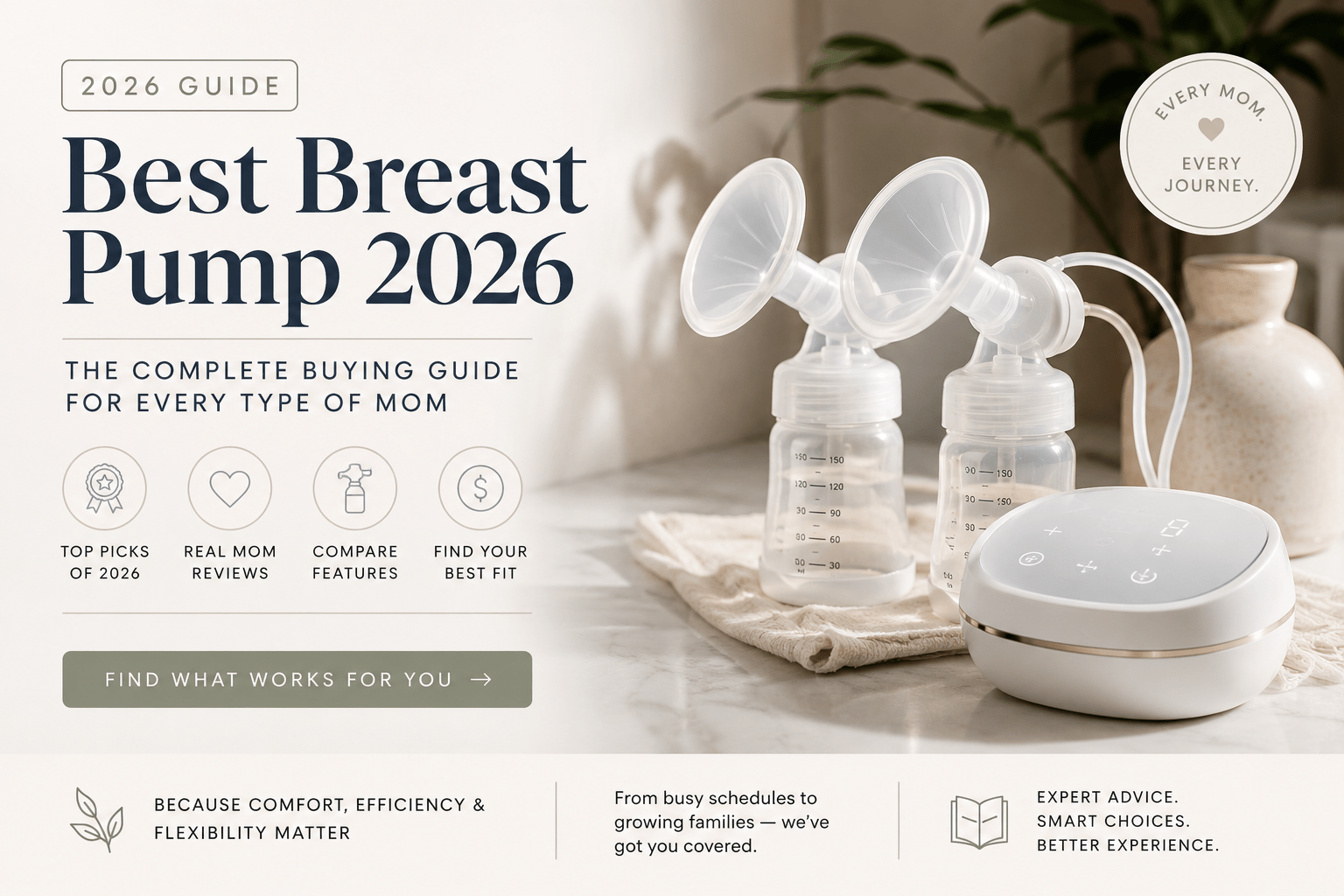
Best Breast Pump 2026: The Complete Buying Guide for Every Type of Mom
Choosing the right breast pump can make or break your feeding routine — whether you’re exclusively pumping, building a backup supply, or heading back to work. With dozens of new wearable, portable, and hospital-grade models released this year, the “best” pump really depends on your lifestyle, budget, and how often you plan to pump.
This guide breaks down the top breast pumps of 2026 by category, with real buying advice, product picks, and answers to the questions parents ask most.
Quick Answer: Our Top Picks at a Glance
- Best Overall: Spectra S1 Plus — hospital-grade suction, rechargeable battery, closed system
- Best Wearable: Eufy S1 Pro — strong suction for a hands-free pump, app tracking
- Best Budget Wearable: Momcozy M5 — affordable, easy to use, four flange sizes included
- Best Portable/Travel: Baby Buddha — compact, powerful motor, long battery life
- Best Manual: Haakaa — silent, no batteries, great for occasional relief or letdown catching
- Best for Exclusive Pumping: Spectra S2 Plus — customizable cycles, plug-in reliability
How We Chose These Pumps
When comparing breast pumps, we weighed the factors that actually affect a parent’s day-to-day experience:
- Suction strength and adjustability — how well the pump empties the breast and whether cycle/vacuum settings can be customized
- Closed vs. open system — closed systems use a barrier to keep milk out of the motor and tubing, which most lactation consultants recommend for hygiene
- Portability — battery life, weight, and whether it fits discreetly in a bag or bra
- Ease of cleaning — number of parts, dishwasher-safe components, and how quickly it assembles
- Insurance coverage — many electric and wearable pumps are available at no cost through insurance in 2026
- Noise level — important for pumping at work or during a baby’s nap
Best Breast Pumps by Category
1. Best Overall: Spectra S1 Plus Electric Breast Pump
The Spectra S1 Plus continues to be viewed by many reviewers and lactation consultants as the gold-standard double electric pump. It offers a rechargeable battery (so you’re not tethered to an outlet), a closed system for hygiene, and gentle-yet-effective suction with adjustable cycle and vacuum settings that mimic a baby’s natural nursing rhythm.
Good for: Moms who pump multiple times a day and want hospital-grade output without being plugged into a wall.
🛒 Related Amazon product recommendations:
- Spectra S1 Plus Electric Breast Pump
- Spectra wide-neck breast milk storage bottles
- Spectra flange inserts (various sizes) for a better pump seal
- Cooler bag with ice packs for transporting pumped milk
2. Best Wearable: Eufy S1 Pro
Wearable pumps have improved dramatically, and the Eufy S1 Pro stands out for suction that’s closer to a traditional electric pump than most tube-free models. It fits fully inside a nursing bra, syncs to an app to track output, and includes a heating element that some parents find helps with letdown.
Good for: Moms who need to pump hands-free at a desk, in the car, or while chasing a toddler.
🛒 Related Amazon product recommendations:
- Eufy S1 Pro wearable breast pump
- Hands-free pumping bra (for backup or double-pump setups)
- Replacement duckbill valves and membranes
- Breast milk storage bags with pour spout
3. Best Budget Wearable: Momcozy M5
The Momcozy M5 is one of the most popular wearable pumps on the market thanks to its lower price point and simple setup. It comes with four nipple/flange sizes (17mm, 19mm, 21mm, 24mm), an app for tracking sessions, and roughly 5.4 ounces of capacity per cup.
Good for: Budget-conscious parents who want to try a wearable pump without a big upfront investment.
🛒 Related Amazon product recommendations:
- Momcozy M5 wearable breast pump
- Momcozy flange inserts and spare parts kit
- Nursing pads for leak protection between sessions
4. Best Portable: Baby Buddha
The Baby Buddha is a compact, tube-connected pump with a surprisingly strong motor and long battery life, making it a favorite for travel and exclusive pumpers who need reliability. Many parents also use it with Spectra-compatible flanges.
Good for: Exclusive pumpers who travel or need a lightweight backup to a full-size electric pump.
🛒 Related Amazon product recommendations:
- Baby Buddha portable breast pump
- Compatible wide-neck flanges and valves
- Portable pump carrying case
- Car charger/adapter for on-the-go pumping
5. Best Manual: Haakaa Silicone Breast Pump
For occasional use, engorgement relief, or catching letdown milk while nursing on the other side, a simple silicone manual pump like the Haakaa is hard to beat. It has no batteries, no motor, and almost nothing that can break.
Good for: Occasional pumping, milk-saving during nursing sessions, or as a lightweight travel backup.
🛒 Related Amazon product recommendations:
- Haakaa silicone breast pump (various sizes)
- Haakaa suction base and stopper
- Silicone milk storage caps
6. Best for Exclusive Pumping: Spectra S2 Plus
The plug-in sibling of the S1, the Spectra S2 Plus offers the same gentle, customizable suction at a lower price point for parents who mostly pump at home or in one location.
Good for: Exclusive pumpers on a budget who don’t need battery portability.
🛒 Related Amazon product recommendations:
- Spectra S2 Plus Electric Breast Pump
- Spectra tubing and backflow protector replacement kit
- Milk storage bottle drying rack
Closed System vs. Open System: Why It Matters
Most lactation experts recommend closed-system pumps, which use a barrier (usually a diaphragm) to physically separate milk from the pump’s motor and tubing. This reduces the risk of mold or bacteria growing inside the tubing and means less cleaning maintenance overall. If you’re choosing between two similar pumps, the closed system is generally the safer long-term pick.
Insurance Coverage in 2026
Thanks to the Affordable Care Act, most health insurance plans in the U.S. cover the cost of at least one breast pump per pregnancy, and many plans now cover popular electric and wearable models with no out-of-pocket cost. Coverage and available brands vary by plan, so it’s worth checking with your insurer or a DME (durable medical equipment) supplier before purchasing out of pocket.
Frequently Asked Questions
What is the best breast pump overall in 2026?
The Spectra S1 Plus remains the top overall pick for most parents thanks to its strong, adjustable suction, closed system, and rechargeable battery.
Are wearable breast pumps as effective as traditional electric pumps?
Wearable pumps offer more freedom and discretion, but they generally produce weaker suction than traditional double electric pumps. Lactation consultants often recommend using a wearable pump alongside a stronger electric pump rather than as a full replacement, since incomplete emptying over time can affect milk supply.
How much does a good breast pump cost?
Prices range widely: manual pumps like the Haakaa start around $15–$30, wearable pumps typically run $150–$300, and hospital-grade electric pumps like the Spectra S1 Plus or Baby Buddha usually cost $200–$300 — though many are available at no cost through insurance.
Can I get a breast pump for free through insurance?
Yes. Most U.S. health insurance plans are required to cover a breast pump under the Affordable Care Act. Many parents can get a mid-range or even premium pump at no cost by ordering through an in-network durable medical equipment (DME) supplier.
How do I know what flange size I need?
Flange size is one of the most important factors for comfortable, effective pumping. Nipple diameter (not breast size) determines the right fit, and many parents need a different size than the one that comes standard with their pump. Most brands sell flange inserts or replacement flanges in multiple sizes so you can find the right fit without buying a new pump.
Is a closed-system pump worth paying more for?
Generally yes. A closed system keeps milk from entering the tubing and motor, which reduces mold risk and cuts down on cleaning time — a meaningful convenience if you’re pumping multiple times a day for months.
Related Reading
- Breastfeeding Essentials: The Complete New Mom Checklist
- Formula Feeding Guide: Everything New Parents Need to Know
- Hospital Bag Checklist: What to Pack for Labor, Delivery & Baby’s First Days
- First Week Home With Baby: The Real Survival Guide (Hour by Hour)
- Best Baby Monitors of 2026: Tested Picks for Every Type of Parent
This article is for informational purposes and reflects publicly available product research as of 2026. Always consult your pediatrician or a lactation consultant for guidance specific to your feeding needs, and check with your insurance provider to confirm current breast pump coverage.