

Artificial Intelligence in Pediatric Pulmonology (2026 Update): Current Tools, Evidence & What Clinicians Need to Know
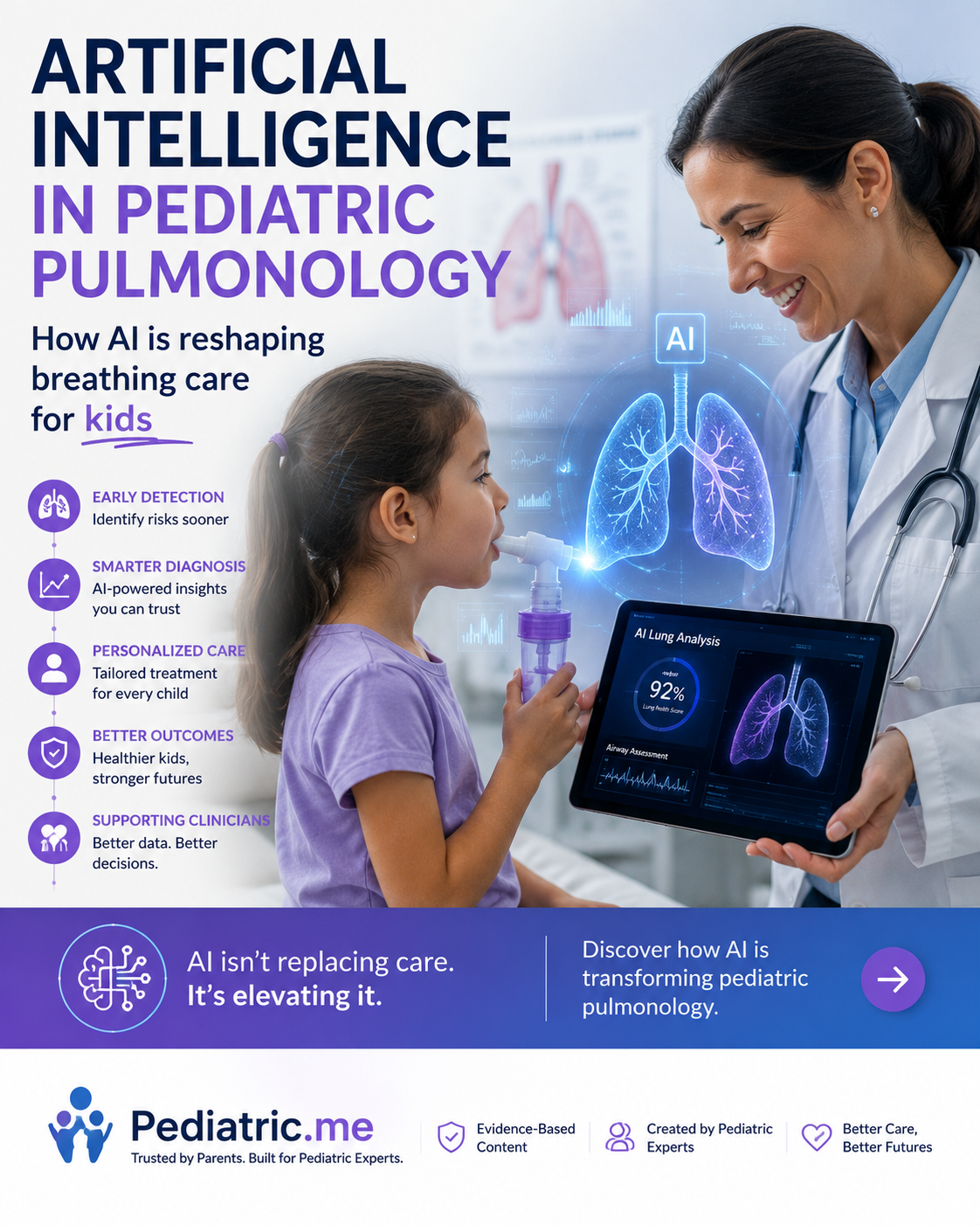
Updated August 2026. Pediatric pulmonology — the branch of medicine focused on children’s lungs and airways — is one of the fastest-moving areas for artificial intelligence in clinical care. Breathing conditions in children are notoriously hard to monitor because kids can’t always describe what they’re feeling, and pediatric-specific AI data has historically lagged behind adult respiratory medicine. That gap is closing quickly in 2026, with new FDA-cleared devices, peer-reviewed pediatric trials, and a shifting regulatory landscape. Below is a current, clinically oriented look at where the evidence actually stands — and how it builds on the broader shift toward AI-assisted pediatric diagnosis already underway across other subspecialties.
Why Pediatric Lungs Are a Hard AI Problem
Children aren’t just small adults. Airways are narrower, lung volumes are still developing, and symptoms like wheezing or shortness of breath are frequently underreported or misread by young patients themselves. Most AI-enabled respiratory devices were trained and validated on adult cohorts first, and a 2026 JAMA Network Open analysis of FDA-regulated AI-enabled medical devices found that those carrying specific pediatric indications remain a small minority of the total field — a gap clinicians should keep in mind when evaluating any tool’s applicability to a specific child’s age and anatomy.
What’s Actually New in 2026
- FDA-cleared wearable stethoscopes moving into pediatric asthma programs: Cedars-Sinai Guerin Children’s launched a home-monitoring program in May 2026 using AeviceMD, an FDA-cleared wireless wearable stethoscope that continuously tracks wheeze detection, heart rate, and respiratory rate and streams the data to clinicians between visits.
- Multimodal model-fusion for exacerbation prediction: A recent international collaboration paired AeviceMD’s continuous respiratory stream with patient-reported app data, processed through a model-fusion AI platform (Jiva AI), analyzing data from 185 patients across multiple sites to improve early warning of asthma attacks.
- EHR-based “passive digital markers” for asthma risk: A 2026 Regenstrief Institute pilot randomized trial (published in Scientific Reports) showed a machine learning tool that mines data already in the EHR — with no extra testing or questionnaires — improved pediatricians’ prognostic accuracy for identifying preschoolers at risk of persistent asthma, adding a data layer on top of standard steps for how asthma is diagnosed in children.
- AI-guided pediatric bronchoscopy evidence is emerging: A 2026 narrative review in Pediatric Pulmonology (Stafler et al.) found AI integration in pediatric bronchoscopy is still early relative to adult endoscopy, but flagged real-time AI classification of airway structures during laryngoscopy/bronchoscopy as a fast-moving area, building on evidence like a 2025 randomized trial showing AI-guided bronchoscopy outperformed human expert instruction for critical-care physicians.
- Lung sound and respiratory signal analysis as a unifying research theme: A 2026 Pediatric Pulmonology special issue call highlights AI-driven analysis of digital-stethoscope auscultation, airflow signals, oxygen saturation trends, and wearable respiratory data as a converging research direction, aimed at making disease detection and progression monitoring more objective and reproducible.
- Machine learning expanding beyond asthma: A February 2026 editorial in a pulmonology journal notes ML research in pediatric chronic respiratory disease is broadening beyond asthma into other chronic conditions, though pediatric datasets remain smaller than adult ones.
Regulatory Landscape Clinicians Should Track
In January 2026, the FDA signaled a broad deregulatory shift for AI-enabled devices and wearables, easing oversight to promote wider adoption of digital health and AI tools. For pediatric pulmonologists, this raises the practical stakes of independently vetting any AI tool’s pediatric validation data rather than assuming clearance implies pediatric-specific performance — a concern echoed directly in the JAMA Network Open review of FDA-regulated AI devices with pediatric indications.
Where AI Is Already Being Used
- Smart spirometry and breath sound analysis: Models trained on breath recordings can flag abnormal wheeze or crackle patterns from a connected stethoscope, sometimes before oxygen levels change.
- Asthma exacerbation risk prediction: Meta-analyses of ML models combining EHR, environmental, and wearable data show they can meaningfully predict hospitalization and ED-visit risk for pediatric asthma exacerbations, though external validation across populations is still limited.
- Imaging support: AI-assisted review of chest X-rays and CT helps flag patterns associated with conditions like bronchopulmonary dysplasia in former preemies.
- Remote monitoring for chronic conditions: Wearable pulse oximeters, connected peak-flow meters, and wireless stethoscopes feed dashboards that alert care teams when a child trends outside their baseline — part of the same broader wave of remote patient monitoring advancements reshaping pediatric chronic-disease management.
- Fellowship education: Programs like Children’s Mercy–Kansas City’s LEAPPT curriculum are now using generative AI to build fellowship training content, testing questions, and flipped-classroom material — an emerging use case beyond direct patient care.
The Limits — and Why the Physician Still Leads
AI tools in pulmonology remain decision-support systems, not diagnosticians. Pediatric-specific training data is still comparatively scarce, models can struggle with rare conditions or very young infants, and most published pediatric asthma-prediction models still need broader external validation before routine clinical deployment. A pediatric pulmonologist has to interpret any AI output in the context of a child’s full history, exam, and family concerns — something no algorithm replicates. Most major pediatric hospital systems treat AI outputs as a flag for clinician review, not a final answer.
Key Questions for Pediatric Pulmonologists Evaluating a New AI Tool
- Was the model validated on a pediatric cohort matching your patient population’s age range and case mix, or extrapolated from adult data?
- What is the tool’s sensitivity/specificity for the specific outcome you’d act on (e.g., exacerbation within 7 days vs. general risk score)?
- Who reviews flagged alerts from a connected device, and on what cadence?
- Has the FDA clearance pathway included a pediatric indication, or is pediatric use off-label extrapolation?
The Bottom Line
2026 is turning out to be an inflection year for AI in pediatric pulmonology: FDA-cleared wearable stethoscopes are moving into real clinical programs, EHR-based risk markers are being tested in randomized trials, and AI-assisted bronchoscopy is starting to accumulate pediatric-specific evidence. At the same time, looser FDA oversight of AI-enabled devices makes independent evaluation of pediatric validation data more important, not less. For now, these tools are best understood as giving pulmonologists better eyes on what happens between visits — not a replacement for clinical judgment.