

Best Infant Thermometer of 2026: A Pediatrician-Informed Buying Guide by Age
Quick answer:
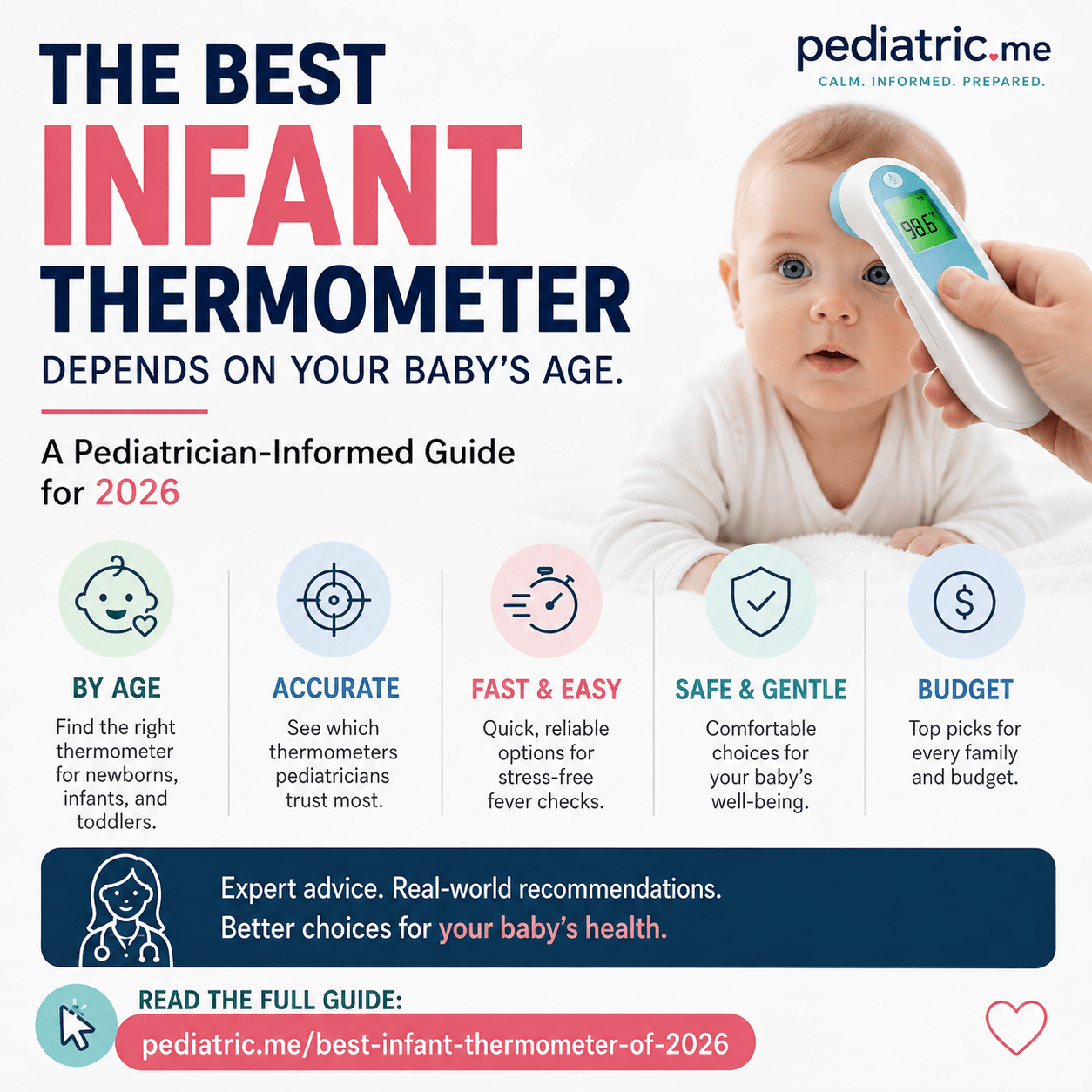
For newborns and infants under 3 months, a digital rectal thermometer like the Frida Baby Quick-Read is still the AAP-recommended gold standard for accuracy. Once your baby is past 3 months, a temporal artery (forehead) or ear thermometer — like the Exergen Temporal Scanner or Braun ThermoScan 7 — is faster and easier for daily fever checks. Below, we break down the best infant thermometers of 2026 by type and age, plus exactly when a fever means it’s time to call your pediatrician.
Why Thermometer Type Matters for Babies
Not every thermometer is appropriate for every age. A forehead scanner that works great on a toddler can give an unreliable reading on a newborn, and many pediatricians will only accept a rectal reading as an official temperature for babies under 3 months. Choosing the right type — not just the most expensive or most popular one — is what actually protects your baby.
Thermometer Types at a Glance
- Rectal: Most accurate for infants; the AAP-preferred method for babies 0–3 months.
- Temporal artery (forehead): Fast, non-invasive, works well starting around 3 months; won’t wake a sleeping baby.
- Tympanic (ear): Convenient and quick, but small ear canals make it less reliable before 6 months.
- No-touch infrared: Fastest and most hygienic for sharing between siblings, though slightly less precise than contact methods.
- Underarm (axillary): A reasonable backup method, but generally the least accurate of the options above.
Best Infant Thermometers of 2026
1. Best Overall for Newborns: Frida Baby Quick-Read Digital Rectal Thermometer
The stopper at the base of the probe prevents over-insertion, the flexible tip is gentle, and it delivers a reading in about 10 seconds. For babies under 3 months, this is the thermometer most pediatric offices will actually trust when you call in a temperature.
Best for: Newborns 0–3 months, and anytime you need the most clinically accurate reading.
2. Best Temporal (Forehead) Thermometer: Exergen Temporal Scanner (TAT-2000C)
This is the same arterial heat-balance technology used in hospitals and pediatric offices. A gentle swipe across the forehead gives a result in about 2 seconds, and it works on a sleeping baby without waking them — a genuine game-changer for overnight fever checks.
Best for: Babies 3 months and older; parents who want hospital-grade accuracy at home.
3. Best Ear Thermometer: Braun ThermoScan 7
A pre-warmed tip prevents falsely low readings, ExacTemp positioning technology confirms correct placement with a light and beep, and results come with color-coded, age-adjusted fever guidance. Most pediatricians recommend waiting until at least 6 months to use ear readings, since younger ear canals are too small for a reliable scan.
Best for: Babies 6 months and up; families who want fast, clinic-style readings at home.
4. Best No-Touch Thermometer: iHealth No-Touch Forehead Thermometer PT3
A one-second, no-contact scan makes this the least disruptive option for a sick, fussy, or sleeping baby. It’s also the easiest to keep hygienic when multiple family members are sharing one device during flu season.
Best for: Quick checks without disturbing a napping or sick baby.
5. Best Multi-Mode Thermometer: Frida Baby 3-in-1 Thermometer
One device that covers ear, forehead, and touchless object/room modes. It’s a practical pick for parents who want to consolidate the number of thermometers in the house as their baby grows from newborn into toddlerhood.
Best for: Parents who want one thermometer that adapts as their baby ages.
6. Best Budget Pick: Vicks SpeedRead
A simple digital stick thermometer that works orally, rectally, or under the arm, with a large backlit display. It lacks the bells and whistles of infrared models, but in independent testing it’s consistently one of the most accurate options on the market — at a fraction of the price.
Best for: Budget-conscious parents who still want clinical-grade accuracy.
7. Best Smart/App-Connected: Kinsa QuickCare
Pairs with a free app to log readings, track fever patterns over time, and share results directly with your pediatrician. Useful if you tend to lose track of “when did the fever start” during a rough night.
Best for: Parents who want to track fever history and share it with their care team.
Comparison Table
| Thermometer | Type | Best Age | Read Time |
|---|---|---|---|
| Frida Baby Quick-Read | Rectal | 0–3 months+ | ~10 sec |
| Exergen Temporal Scanner | Forehead/Temporal | 3 months+ | ~2 sec |
| Braun ThermoScan 7 | Ear | 6 months+ | ~2–3 sec |
| iHealth PT3 | No-touch infrared | 3 months+ | ~1 sec |
| Frida Baby 3-in-1 | Ear/Forehead/Touchless | 3 months+ | ~2–3 sec |
| Vicks SpeedRead | Oral/Rectal/Underarm | 0 months+ (rectal mode) | ~8–10 sec |
| Kinsa QuickCare | Oral/Rectal/Underarm + app | 0 months+ | ~8 sec |
🛒 Shop These Picks on Amazon
Prices and availability change frequently, so we’ve linked directly to live Amazon search results for each pick rather than a single product page that can go out of stock or get discontinued:
- Frida Baby Quick-Read Digital Rectal Thermometer
- Exergen Temporal Scanner (TAT-2000C)
- Braun ThermoScan 7 Ear Thermometer
- iHealth No-Touch Forehead Thermometer PT3
- Frida Baby 3-in-1 Thermometer
- Vicks SpeedRead Digital Thermometer
- Kinsa QuickCare Smart Thermometer
As an Amazon Associate, this site may earn from qualifying purchases.
How to Get the Most Accurate Reading
- Wait at least 20–30 minutes after feeding, bathing, or bundling before taking a temperature — all three can cause a temporary false-high reading.
- For rectal readings, insert only about ½ inch for babies under 6 months, and use a small amount of lubricant.
- For ear readings, gently pull the ear back and up (not down) to straighten the ear canal for an accurate scan.
- Clean the thermometer tip with 70% isopropyl alcohol between uses, especially when sharing between siblings.
- Keep a log of readings and the time they were taken — your pediatrician will likely ask.
When a Fever Means It’s Time to Call the Pediatrician
According to AAP and Mayo Clinic guidance, a fever is generally defined as 100.4°F (38°C) or higher. What counts as urgent depends heavily on age:
- Under 3 months: Any rectal temperature of 100.4°F or higher is a same-day medical concern — call your pediatrician or go to the ER, regardless of how your baby looks.
- 3–6 months: Call if your baby has a fever and seems unusually irritable, lethargic, or uncomfortable.
- 6 months and up: Use your judgment alongside other symptoms — how your baby is feeding, breathing, and behaving matters as much as the number on the screen.
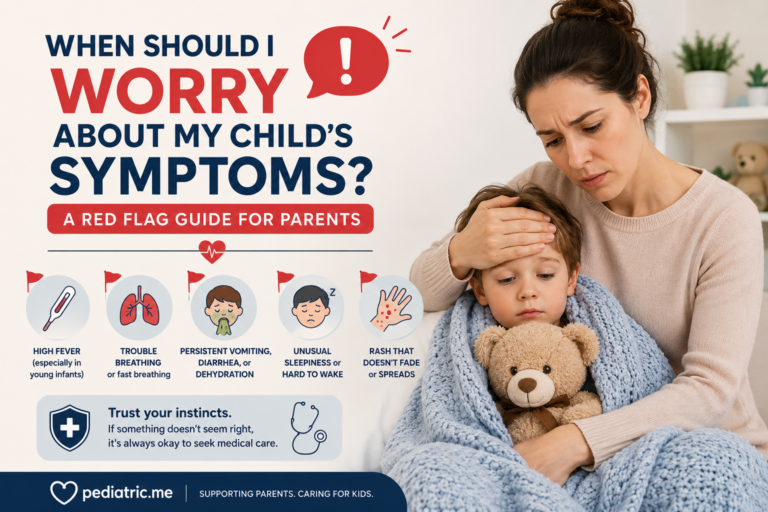
For a full breakdown of red-flag symptoms beyond fever, see our guide on when to worry about your child’s symptoms.
FAQ: Best Infant Thermometers
What is the most accurate thermometer for a newborn?
A digital rectal thermometer is considered the most accurate method for newborns and infants under 3 months, since it measures core body temperature directly rather than surface or arterial heat.
Are forehead thermometers accurate for babies?
Temporal artery (forehead) thermometers are generally accurate for babies 3 months and older. They’re less reliable for newborns, where a rectal reading is still preferred.
At what age can I start using an ear thermometer?
Most manufacturers and pediatricians recommend waiting until at least 6 months, since younger babies’ ear canals are too small and curved for a consistently accurate tympanic reading.
How many thermometers do I actually need?
Most pediatric guides recommend at least two: a rectal thermometer for the newborn stage and clear confirmation readings, plus a forehead or ear thermometer for fast, non-invasive checks as your baby grows.
What temperature counts as a fever in a baby?
Generally, 100.4°F (38°C) or higher is considered a fever. For babies under 3 months, this threshold is treated as a same-day medical concern.
Do I need to clean the thermometer between uses?
Yes. Wipe the tip or probe with a cloth or cotton ball moistened with 70% isopropyl rubbing alcohol between uses, especially if more than one family member uses the same device.
Related Reading
- When Should I Worry About My Child’s Symptoms? A Red-Flag Guide for Parents
- When to Worry About a Fever and How to Manage It at Home
- Best Baby Monitors of 2026: Tested Picks for Every Type of Parent
- Newborn Essentials: The Ultimate Baby Registry Checklist
- First Pediatrician Visit: What to Expect & What to Bring
This article is for educational purposes and reflects general pediatric guidance current as of 2026. It is not a substitute for medical advice — always consult your child’s pediatrician about fever management specific to your baby.