


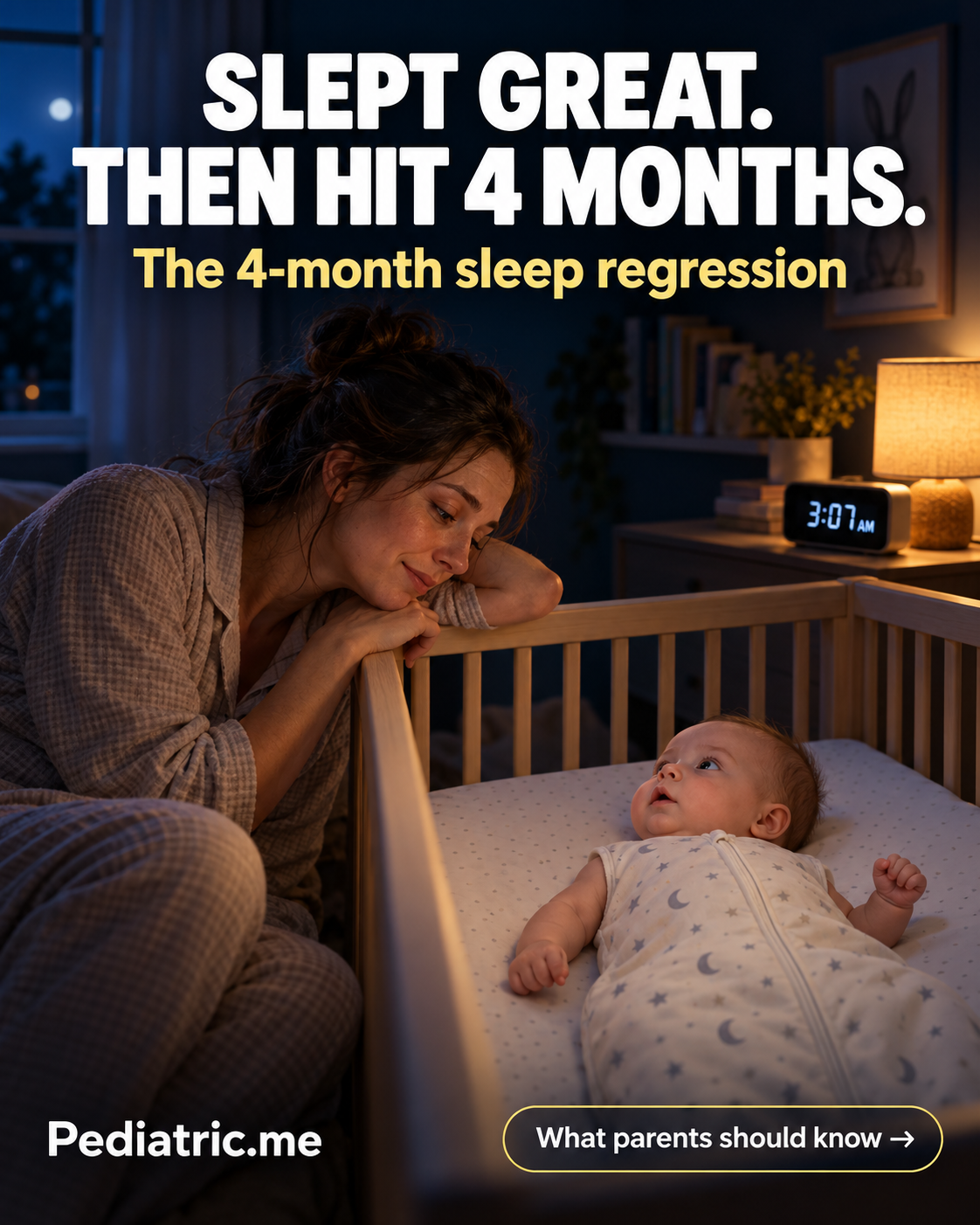
The 4-Month Sleep Regression: Signs, How Long It Lasts and What Helps
Quick answer: The 4-month sleep regression is a stretch of more frequent night waking, shorter naps and extra fussiness that many babies go through around 3 to 4 months of age. It happens because a baby’s sleep is maturing: instead of spending most of the night in deep sleep, babies start cycling between deep and light sleep like adults do, and they wake more easily between cycles. It is a normal developmental change, not a sign that anything is wrong, and it usually lasts a week or two. What helps most is a short, calm bedtime routine, putting your baby down drowsy but awake, plenty of feeding during the day, and keeping every sleep safe: on the back, on a firm flat surface, with nothing soft in the crib. Stop swaddling as soon as your baby shows signs of trying to roll.
What is the 4-month sleep regression?
“Sleep regression” is the everyday name for a period when a baby who was sleeping fairly well suddenly starts waking more often or fighting sleep. The one parents hear about most is the 4-month sleep regression, because it lines up with a big change in how babies sleep.
Newborns spend a lot of their sleep in deep sleep and don’t yet have a mature body clock (circadian rhythm). The American Academy of Pediatrics (AAP) notes that babies don’t have regular sleep cycles until about 4 months of age. As those cycles develop, babies move between deep and lighter sleep through the night. Lighter sleep means more chances to wake up, and a baby who has always fallen asleep while being fed or rocked may not yet know how to drift back off alone.
One honest caveat: “regression” is a popular term, not a medical diagnosis. Cleveland Clinic points out that research hasn’t shown regressions happening at one set age for every baby. Some babies have a rough patch at 3 months, some at 5, and some barely notice a change. Other unsettled stretches can come with growth spurts and new skills later in the first year.
Signs of the 4-month sleep regression
- Waking more often at night, sometimes every hour or two after previously longer stretches
- Shorter or fewer naps, or naps that end soon after they start
- Taking longer to fall asleep, with more crying or fussing at bedtime
- More fussiness overall during the day from being overtired
- Wanting to feed or be held more to get back to sleep
Babies around this age are also learning to roll, reach and notice the world around them, and that extra excitement can make settling harder.
Is it the regression, or something else?
Not every bad night is a regression. Hunger, a wet or dirty diaper, being too warm or too cold, and illness can all wake a baby. Teething can also disturb sleep, though most babies get their first tooth closer to 6 months (see our guide to teething in babies). If your baby has a fever, a cough or congestion, is feeding poorly, or just seems unwell, think illness first, not regression. Our red-flag symptom guide can help you decide.
How long does the 4-month sleep regression last?
For most babies it lasts about one to two weeks. It isn’t really a step backward. It’s a permanent change in how your baby sleeps, so the goal is to help your baby learn to link sleep cycles, not to wait for the “old” sleep to come back. Many families find nights settle once the new routine clicks.
It also helps to keep expectations realistic. The UK’s NHS notes that between 3 and 6 months some babies sleep 5 to 8 hours or more at night, but not all do, and many still need night feeds. Waking at night is still normal at this age.
What helps: tips for the 4-month sleep regression
- Keep a short, predictable bedtime routine. The same few calm steps every night signal that sleep is coming: for example a bath, pajamas and a fresh diaper, a feed, a quiet song or book, then into the crib. Keep it short and simple so it’s easy to repeat every night.
- Put your baby down drowsy but awake. The AAP suggests that from about 4 months, babies go into bed drowsy rather than already asleep. Learning to fall asleep in their own bed helps them resettle on their own when they wake between sleep cycles. Rocking or feeding all the way to sleep can make night wakings harder.
- Pause before you respond. Babies often grunt, squirm or fuss briefly between cycles. Giving your baby a few minutes to settle can help them learn to fall back asleep. Always go in if your baby needs a feed, a diaper change or comfort because they’re sick.
- Make day feel like day and night feel like night. Open the curtains, talk and play during daytime. For night feeds and changes, keep lights dim, voices low and play to a minimum.
- Feed well during the day. Full feeds during waking hours can reduce how often hunger wakes your baby at night. Feeding a little before the final steps of the routine, rather than to sleep, can also help.
- Watch for sleepy cues. Yawning, eye rubbing and staring off are signs to start winding down. An overtired baby often has a harder time falling asleep.
- Keep the room calm. A dark room, a comfortable temperature and steady white noise can help. Skip screens and lively play right before bed.
- Look after yourself, too. Share night duties if you have a partner, nap when you can, and accept help from family or friends.
Safe sleep during the 4-month sleep regression
Tired parents sometimes reach for whatever gets the baby to sleep. The AAP’s safe sleep advice still applies at every nap and every night until your baby turns 1:
- Back to sleep, every time. Always place your baby on their back. Rolling usually starts around 3 to 4 months. If your baby can roll both ways on their own, you don’t need to flip them back, but always start them on their back.
- Stop swaddling when rolling starts. The AAP says to stop swaddling as soon as your baby shows any sign of trying to roll. Sleep sacks that wrap the arms or chest should stop then too. A loose sleep sack that lets your baby move their arms freely is fine.
- No weighted products. Don’t use weighted sleep sacks, swaddles or blankets. They can press on a baby’s chest and lungs.
- Firm, flat surface only. Use a crib or bassinet with just a fitted sheet. No pillows, blankets, bumpers or soft toys. Any surface inclined more than 10 degrees isn’t safe for sleep.
- Move sleeping babies. If your baby falls asleep in a car seat, swing, stroller or carrier, move them to a firm, flat surface on their back as soon as you can.
- Room-share, don’t bed-share. Keep your baby’s crib in your room for at least the first 6 months. The AAP advises against sharing a bed with your baby.
- Offer a pacifier at sleep times if your baby takes one (once breastfeeding is going well). Never tie it to your baby’s clothes or neck.
For more on setting up safe sleep, see our newborn sleep and safe sleep guide.
Is it time to sleep train?
Some parents wonder whether the 4-month regression is the moment to start formal sleep training. Many pediatricians suggest waiting until closer to 6 months, once your doctor confirms your baby is growing well and may be ready to go longer without night feeds. Riley Children’s Health notes that a small study found methods like graduated extinction (checking in at gradually longer intervals) and bedtime fading helped babies fall asleep faster and wake less, with no differences in emotional health or attachment at 12 months. The study was small, so it can’t fully rule out long-term effects. Whatever you choose, keep checking on your baby, and talk with your pediatrician first.
When to call the doctor
- Your baby has a fever or seems sick (see when to call the pediatrician about a fever)
- Your baby is feeding much less than usual or has fewer wet diapers (our guide on whether your baby is getting enough milk can help)
- Your baby snores loudly, pauses in breathing or breathes noisily during sleep
- Your baby cries in a way that sounds like pain, or can’t be comforted
- Poor sleep lasts more than a few weeks with no improvement
- Your baby is losing skills they had, such as no longer smiling, holding up their head or responding to you
- You feel overwhelmed, hopeless or worried you might hurt yourself or your baby. Exhaustion is real, and your doctor can help.
When to go to the ER or call 911
- Your baby is struggling to breathe, or their lips, face or skin look blue or gray
- Your baby is limp, very hard to wake, or unresponsive
- Your baby has a seizure
- Your baby stops breathing, even briefly, or you find them unresponsive in their sleep space
Frequently Asked Questions
When does the 4-month sleep regression start?
It often starts around 3 to 4 months of age, when babies’ sleep cycles begin to mature. The timing varies: some babies have it a little earlier or later, and some barely have it at all.
How long does the 4-month sleep regression last?
The 4-month sleep regression usually lasts about one to two weeks. Because it reflects a lasting change in how a baby sleeps, a consistent bedtime routine and putting your baby down drowsy but awake help sleep settle sooner.
Why does the 4-month sleep regression happen?
Around 4 months, babies start cycling between deep and light sleep like adults. They wake more easily between cycles, and babies used to being fed or rocked to sleep may need help learning to fall back asleep on their own.
Should I stop swaddling during the 4-month sleep regression?
Stop swaddling as soon as your baby shows any sign of trying to roll, which often happens around 3 to 4 months. Switch to a loose sleep sack that leaves the arms free, and never use a weighted swaddle or sleep sack.
Is my 4-month-old hungry or going through a sleep regression?
Many 4-month-olds still need night feeds, so hunger is a common reason for waking. If your baby feeds well and settles quickly, they were likely hungry. If they wake often but take only a little, it may be sleep cycle changes. Ask your pediatrician if you’re unsure.
Can I sleep train during the 4-month sleep regression?
Many pediatricians suggest waiting until around 6 months for formal sleep training, after checking that your baby is growing well. You can start good habits now, like a bedtime routine and putting your baby down drowsy but awake.
Is the 4-month sleep regression a sign something is wrong?
No. It’s a normal part of sleep development. But fever, poor feeding, breathing problems, or a baby who seems sick or can’t be comforted are not part of a sleep regression, so call your pediatrician if you see them.
Related guides
- Newborn Sleep Tips: Safe Sleep and Schedule Guide
- Teething in Babies: Signs, Timeline and Safe Relief
- Is My Baby Getting Enough Breast Milk or Formula?
- When to Call the Pediatrician About a Fever
- When Should I Worry About My Child’s Symptoms?
Sources
- AAP (HealthyChildren.org): Getting Your Baby to Sleep
- AAP (HealthyChildren.org): How to Keep Your Sleeping Baby Safe
- AAP (HealthyChildren.org): Swaddling: Is It Safe?
- Cleveland Clinic: The 4-Month Sleep Regression
- NHS: Helping Your Baby to Sleep
- Riley Children’s Health: Does Sleep Training Cause Long-Term Harm?
This article is for general information and is not a substitute for advice from your child’s doctor.